Humour and relationships
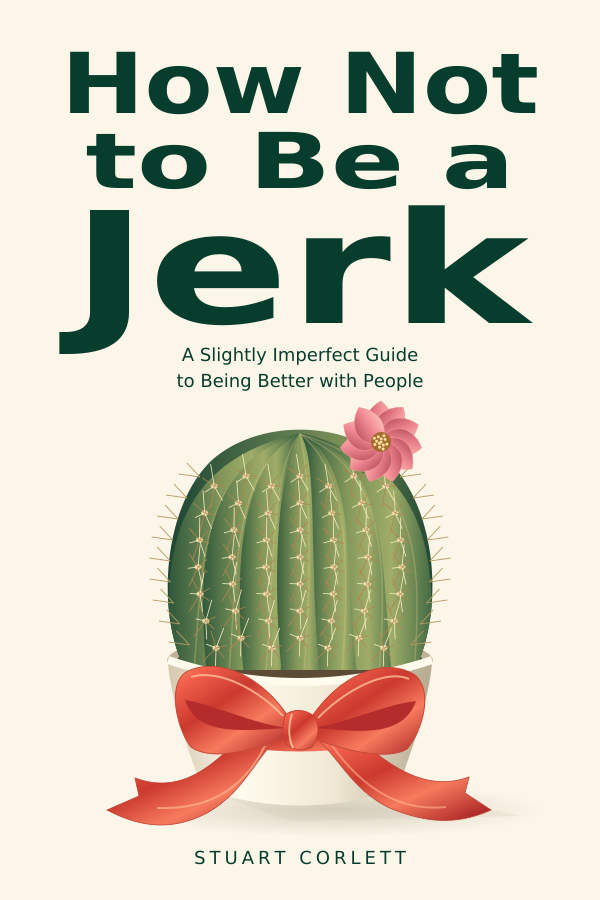
How Not to Be a Jerk
A humorous, self-reflective guide to listening, boundaries, apologies and the everyday business of being better with other people.
View book
Identity and integrity · Stuart Corlett
Personas, Identity, and Integrity in Everyday Life
Many faces. One life to answer for.
Also available as a popular edition.
We meet the world as parents, friends, professionals, customers and members of communities. Even within one role, our manner changes with the person in front of us. Who am I? begins with these ordinary encounters to explore how personas develop, what they protect and what they invite others to trust.
Drawing on psychological and sociological research alongside philosophical argument, Stuart Corlett examines self-knowledge, privacy, deliberate development, social influence and the demands of belonging. The inquiry asks how we understand our private selves while listening to the people affected by our conduct.
At its centre is accountable coherence: an ethical proposal for examining our commitments, responsibilities and capacity to change. Rather than requiring every facet to look identical, the book asks what each persona offers and what remains ours to answer for.
Read before you choose
Chapter One · One Day Many Faces
To one person, I am a medical professional. To another, I am a writer. Someone listening to me speak encounters the public speaker; someone working alongside me across cultures encounters another aspect of my life. I am a father, a friend, a customer, and a member of a faith community. These descriptions belong to the same person, although nobody meeting me in one of these settings necessarily sees everything the others see.
Even this list is too simple. I may be different with one child from how I am with another. With one customer, I might be funny; with another, serious. The role remains the same, but the encounter changes. The person in front of me matters.
This is where the question of persona becomes interesting. If I describe myself only by my roles, I miss the particular relationships through which I live them. If I describe every change in manner as a separate self, I may create distinctions that explain very little. We need a way to acknowledge the variety without losing sight of the person whose conduct connects these encounters.
The central question of this book is how we can express different facets of ourselves while remaining accountable for what we do. It begins with something ordinary: the adjustment of voice, attention, humor, authority, or disclosure when we meet another person. It follows these adjustments into questions about privacy, self-knowledge, the person we hope to become, and the influence other people exert over that development.
End of sample · © Stuart Corlett
Keep exploring
A humorous, self-reflective guide to listening, boundaries, apologies and the everyday business of being better with other people.
View bookA reflection on Jesus, compassion and community-led development in Shan State, presented in a popular, accessible edition.
View bookA research-informed examination of faith, influence and power that asks how Christians can speak with conviction while protecting another person’s freedom.
View book
