Humour and relationships
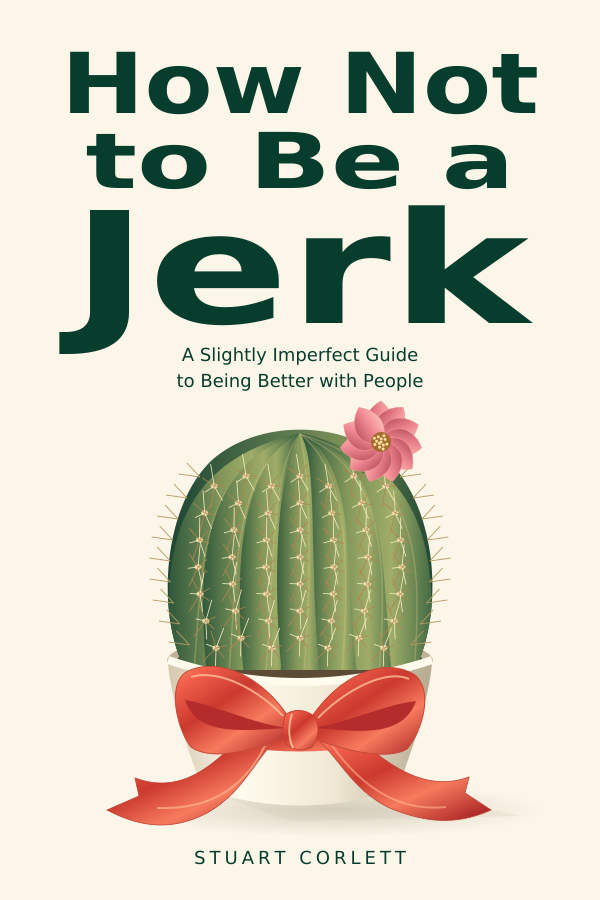
How Not to Be a Jerk
A humorous, self-reflective guide to listening, boundaries, apologies and the everyday business of being better with other people.
View book
The Future · Nonfiction · Stuart Corlett
Power, Compassion, AI, and the Civilization We Could Become
What kind of civilization would be worth becoming?
Also available from
Check the selected Apple Books store for editions and availability.
We can imagine longer lives, extraordinary artificial intelligence, and a civilization drawing on the energy of a star. But who would share in those possibilities? Who would make the decisions? And how far would our care reach?
Beginning with a child’s uncertain future in a jungle clinic near the Thailand–Myanmar border, Stuart Corlett explores the distance between what humanity can do and what a person can actually receive.
The Future We Care For brings medicine, technology, grief, ecology, and the power of institutions into a hopeful conversation about the lives we want to make possible. Moving from everyday acts of care to the furthest horizons of human ambition, it asks how compassion and capability might grow together.
Part of The Future, a series of fiction and nonfiction exploring the issues humanity faces as we look ahead, this book invites readers to imagine more boldly, question more carefully, and help shape a world our children can look forward to.
Read before you choose
Prologue · The Reach of Our Care
Imagine that we learn to gather the energy of a star.
Across distances that now defeat us, our descendants build places to live. They repair damage within the body that we can scarcely understand, let alone mend. An illness that once ended a life becomes an interruption in it. People who would have died young have time to grow old, and perhaps growing old itself means something different. A century becomes a season in a human life.
We cannot know whether such a future is possible. But we can begin to ask what we would want from it.
Who would get the extra time? Who would make the decisions? Would a person born far from the centers of wealth have reason to welcome these achievements? Would the people doing the caring have lives of their own, with enough rest and freedom to enjoy them? And would the living world that sustained our ascent remain a home?
The answers would tell us something that the size of our machines could not.
I want to know what medicine might yet make possible, what intelligence might help us understand, and how far life might travel. Yet whenever I try to picture that future, I find myself returning to a room with very little equipment and a child we did not know how to help.
In 2009, I was in a jungle clinic near the border between Thailand and Myanmar. I had come with a doctor from New Zealand, also named Stu. We were working toward starting a medical school in the area. The aim was to help develop medical knowledge and training where they were urgently needed.
The boy was eight years old. His name was Sai Boi.
His body was twisted into severe muscle contractions. He had a longstanding scabies infection, and we feared that complications of infection had affected his kidneys. The clinic had very few medicines. Whatever the precise sequence of illness, we were looking at a child who was desperately unwell.
We were preparing to leave. I was returning to Chiang Mai, where I lived, and Stu had a flight back to New Zealand. Those arrangements belonged to an orderly world of roads, departures, and onward journeys. Sai Boi’s situation had no such clear next step. We had reached the limits of what we could think to do with what was available.
End of sample · © Stuart Corlett
Keep exploring
A humorous, self-reflective guide to listening, boundaries, apologies and the everyday business of being better with other people.
View bookA reflection on Jesus, compassion and community-led development in Shan State, presented in a popular, accessible edition.
View bookA research-informed examination of faith, influence and power that asks how Christians can speak with conviction while protecting another person’s freedom.
View book
