Philosophy and psychology
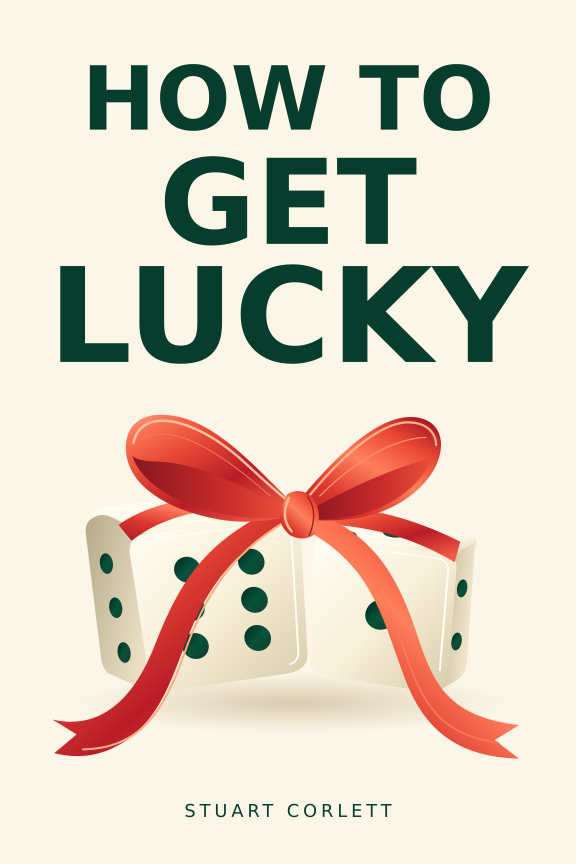
How to Become Luckier
A thoughtful exploration of chance, belief and responsibility—and a practical guide to meeting uncertainty more intelligently.
View book
Philosophy of mind and relationships · Stuart Corlett
On Consciousness, Belief and Each Other
Each of us receives only a portion of what is there.
Most of us believe that with enough time and goodwill we could understand the people around us completely. The evidence says otherwise. Couples who have shared a home for a decade guess each other's views far worse than they expect. Twins confidently claim the same childhood memory as their own. Honest people look at the same photograph and see different colours.
Whether the brain produces the mind or shapes a consciousness larger than itself, every account agrees on one thing: each of us receives only a portion of what is there, shaped by a body, a language and a history we never chose.
Why Listening Works follows that insight from the philosophy of consciousness through psychology, neuroscience and the world's spiritual traditions into ordinary life. It shows why imagining another's view fails where asking succeeds—and why non-judgemental attention can expand what any one of us is able to see.
Read before you choose
Chapter One · The Smashed Radio
If you take a radio that is playing a symphony and strike it hard enough with a hammer, the music stops. If you damage it more gently — loosen a wire, crack a valve, dent the speaker — the music does not stop but changes: it crackles, fades, distorts, loses its high notes or its low ones. Repair the damage and the music returns. Every one of these observations is reliable and repeatable, and a careful enough investigator could build from them a detailed map of which parts of the radio correspond to which features of the sound.
And yet nobody who has ever done this has concluded that the radio was composing the symphony.
It seems a trivial point, and in one sense it is. But it touches on a question that most of us consider long settled, and which turns out, on examination, to be considerably more open than we suppose. We know that consciousness depends on the brain. We know it with the same kind of confidence that the investigator has about the radio: an anaesthetic switches experience off and a reversal agent switches it back on; a blow to the head can erase a morning; damage to one small region can remove the ability to recognise faces while leaving everything else intact; a drug can colour the whole world with joy or dread. From this evidence almost everyone, scientist and non-scientist alike, draws the conclusion that seems to follow as naturally as night follows day: the brain makes the mind, in the way that a kettle makes steam.
That conclusion may well be true. But it is worth noticing that the radio produces exactly the same pattern of evidence — damage it and the music changes, destroy it and the music stops — and that in the radio's case the natural conclusion would be false. The evidence alone, it seems, does not tell us which kind of thing we are looking at. Something else is doing the work.
This chapter is about that something else, and about the first person to see clearly that it was there.
In 1898 William James was invited to give the Ingersoll Lecture at Harvard, an annual address established to consider the question of human immortality. James was then among the most distinguished psychologists and philosophers in the world, the author of a vast and still-admired textbook on the principles of psychology, and a thinker with a rare gift for making difficult ideas feel like common sense. He published the lecture that year under the title Human Immortality: Two Supposed Objections to the Doctrine, and the first of those objections is the one that concerns us here.
End of sample · © Stuart Corlett
Keep exploring
A thoughtful exploration of chance, belief and responsibility—and a practical guide to meeting uncertainty more intelligently.
View bookA playful title for a thoughtful book about chance: widen your opportunities, question comforting myths and make wiser choices.
View bookAn interdisciplinary exploration of how beliefs shape identity, health, belonging and conflict—and how curiosity can help us live together more beautifully.
View book