
Philosophy and psychology
Bereavement
How do I live without you? An inquiry into bereavement, continuing bonds, and the possibility of pleasure while love and sorrow remain.
View book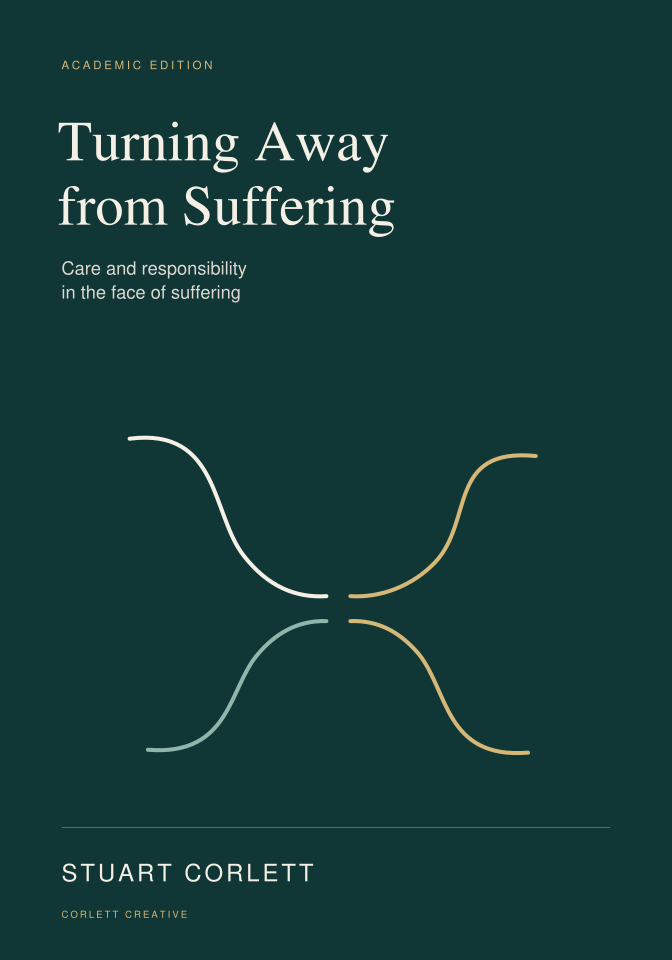
Loss, Mortality and Care · Book 3 · Stuart Corlett
Care and responsibility in the face of suffering
What happens when another person’s suffering feels too close?
Also available from
Check the selected Apple Books store for editions and availability.
Popular-edition cover artwork. Original photograph: Priscilla Du Preez / Unsplash; painterly adaptation.
Do we sometimes turn away because suffering awakens fears about our own lives, the people we love, and our mortality?
Stuart Corlett investigates that possibility alongside competing explanations: emotional effort, identity, uncertainty, information avoidance, and doubts about whether help will work. The argument distinguishes a plausible explanation from an established cause.
Dated documentary cases concerning Gaza and Myanmar keep local knowledge, organized assistance, and the lives of affected people at the center. Chapters on media, institutions, pleasure, and shared responsibility ask what sustained concern requires when feelings are unreliable.
This academic edition moves from the psychology of withdrawal to an ethical question: what can we reasonably do, and how can our response remain useful and open to correction?
Read before you choose
From the Introduction · The Question Behind Withdrawal
Do we sometimes turn away from the suffering of others because it brings us closer to fears about our own lives, the people we love, and our mortality? The question begins with a possibility. Other people's vulnerability can make the security of our own world harder to assume. Yet the word “sometimes” carries much of the intellectual responsibility. It prevents the possibility from becoming a diagnosis imposed on everyone who closes a news report, declines an appeal, or stops a conversation.
This book asks when the proposed mechanism might operate, what competing explanations deserve consideration, and what follows ethically even when the motive remains uncertain. It distinguishes attention from emotion and emotion from action. A person can watch suffering closely while providing no assistance. Another can limit exposure to disturbing images while making a sustained practical contribution. The visible act of looking does not, by itself, identify the moral significance of a response.
The argument is that responsibility cannot depend entirely on our capacity to remain emotionally overwhelmed. Feelings matter, but the needs and claims of other people do not disappear when our feelings fluctuate. A defensible response must connect attention to judgment, capability, and action. That connection can include limits and rest without allowing comfort to become an unlimited reason for withdrawal.
Psychology and ethics play different roles in this inquiry. Psychological research can investigate why people avoid information or helping. Ethical argument examines which reasons justify a decision and what obligations remain. An explanation does not automatically excuse a behavior. A condemnation does not establish its psychological cause. Maintaining that distinction will make both parts of the book more demanding and more useful.
Gaza and Myanmar enter as situated areas of inquiry. They are not interchangeable illustrations of tragedy, and their inhabitants are not merely stimuli through which distant observers discover their own feelings. The case chapters examine bounded, dated sources on local humanitarian work, historical conditions, and political agency. Their purpose is to establish what an ethical response must attend to, rather than to infer audience motives from the suffering itself. That boundary is essential to the integrity of the argument.
The companion books concern the loss of someone close and the knowledge of one's own ending. This volume asks how those vulnerabilities may shape our relationship to people beyond the immediate circle. It also asks what can sustain concern: practical efficacy, reliable institutions, relationships, humor, beauty, play, and the ordinary pleasures of a life that remains open to others.
End of sample · © Stuart Corlett
Keep exploring
How do I live without you? An inquiry into bereavement, continuing bonds, and the possibility of pleasure while love and sorrow remain.
View bookHow do I live with myself knowing I will end? A philosophical and psychological inquiry into death anxiety, afterlife beliefs, and the value of a finite life.
View bookA thoughtful exploration of chance, belief and responsibility—and a practical guide to meeting uncertainty more intelligently.
View book
