Philosophy and psychology
Living with Mortality
How do I live with myself knowing I will end? A philosophical and psychological inquiry into death anxiety, afterlife beliefs, and the value of a finite life.
View book
Loss, Mortality and Care · Book 1 · Stuart Corlett
How do I live without you?
How can we keep living without leaving love behind?
Also available from
Check the selected Apple Books store for editions and availability.
Popular-edition cover artwork. Original photograph: Aaron Burden / Unsplash; painterly adaptation.
The death of someone we love changes more than how we feel. It changes routines, relationships, responsibilities, and the future we thought we would share.
In Bereavement, Stuart Corlett brings psychological research into conversation with philosophical inquiry to examine grief without imposing a compulsory timetable. He explores continuing bonds, belief and reunion, guilt, loneliness, family life, and losses that receive too little recognition.
Humor, beauty, play, and ordinary pleasure also have a place. Their return need not betray the person who died, just as continuing sorrow need not mean that life has stopped.
This academic edition offers a carefully qualified argument for remembrance, support, and a life that can change while love remains significant.
Read before you choose
From the Introduction · The Person Who Is Missing
Bereavement begins with a fact about someone else. A person has died. Whatever the death brings into view about our own vulnerability, the loss has an object beyond ourselves: someone whose presence made a difference and whose absence cannot be answered merely by making us feel safer. This book starts there because an explanation of grief can become strangely inattentive to the dead. It can interpret every attachment as protection against anxiety and every sorrow as a disturbance to be corrected, until the particular person almost disappears from the account.
The question “How do I live without you?” resists that disappearance. The word “you” specifies a relationship. The word “live” includes work, money, bodily needs, friendships, responsibilities, and pleasures. A convincing account must explain how these dimensions can change together without assuming that they change in one direction or on one timetable. It must also allow the question to mean different things after a spouse's death, a child's death, the death of an estranged parent, or the death of someone whose importance was never publicly recognized. Those situations are not interchangeable research populations.
The argument developed here is that living after loss need not require ending the significance of the relationship. It can involve revising the relationship's place in one's life while acknowledging that the person is no longer available in the ways they were. This proposition leaves considerable room for disagreement about memory, ritual, belief, and responsibility. It also leaves room for people who do not want to maintain an active sense of connection. An account that replaces an obligation to relinquish the dead with an obligation to remain attached would repeat the same mistake in another form.
The book combines psychological research with conceptual and ethical argument. These methods answer different questions. A longitudinal study can describe changes in distress; it cannot decide how much sorrow constitutes adequate loyalty. Interviews can disclose experiences that a questionnaire misses; they cannot establish how common those experiences are in a population they did not sample. Philosophical analysis can clarify what a demand for acceptance entails; it cannot demonstrate that a particular conversation will relieve suffering. The reader should be able to tell which kind of claim is being made.
The companion books extend the inquiry in two directions. Living with Mortality asks about one's own ending. Turning Away from Suffering asks whether other people's vulnerability can produce withdrawal and what responsibility survives that withdrawal. Bereavement connects to both, but it has its own center. The death of a loved person is neither merely a rehearsal for one's own death nor merely one example of suffering elsewhere. The task is to understand the relationship that has changed and the life that must now be lived.
End of sample · © Stuart Corlett
Keep exploring
How do I live with myself knowing I will end? A philosophical and psychological inquiry into death anxiety, afterlife beliefs, and the value of a finite life.
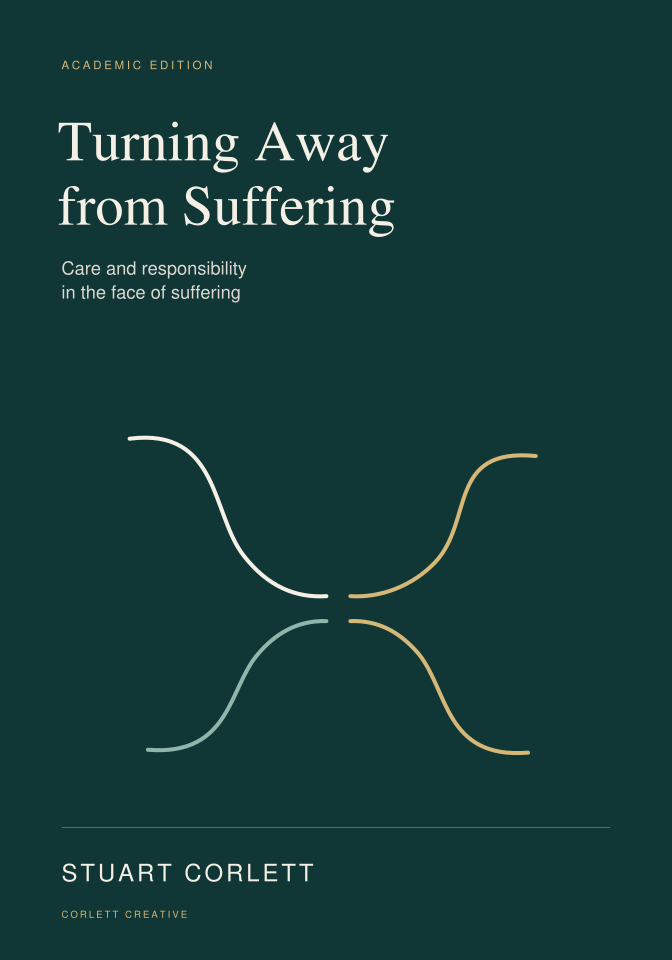
View bookDo we turn away from suffering because it awakens fears about our own lives? An inquiry into attention, avoidance, care, and shared responsibility.
View bookA thoughtful exploration of chance, belief and responsibility—and a practical guide to meeting uncertainty more intelligently.
View book