
Ukraine · Maksym Kovalenko · Book 1
The Unbroken Sky
A young Ukrainian inventor begins turning the fragments of war into a vision of protection, as courage, love and conscience shape what he builds.
View book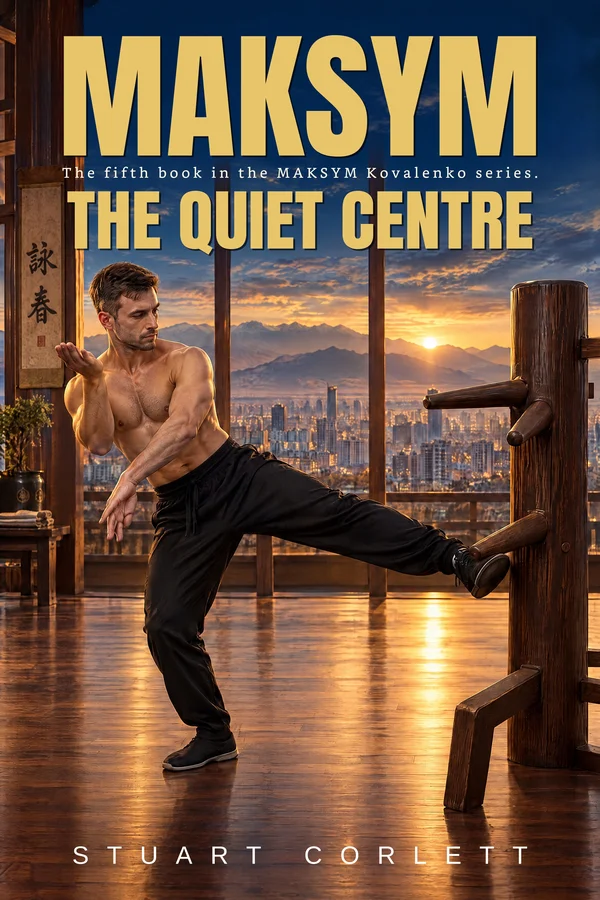
Ukraine · Maksym Kovalenko · Book 5 · Stuart Corlett
How do you protect what you love without losing who you are?
Maksym has helped others imagine a more peaceful world. Now he must protect the people closest to him.
When he refuses a powerful crime boss, the threat reaches his family. A chance meeting over a game of Go leads Maksym, Kateryna, and their daughter to Mongolia, where an elderly Wing Chun master offers a different kind of education.
Training begins with simple movements: how to stand, how to listen, how to stop forcing an answer. But fear does not stay outside the practice room. As Maksym learns to read Sun Tzu in Chinese, he must decide which lessons can serve the love he refuses to abandon.
With danger gathering around them, husband and wife discover that protecting their family will demand more than skill. It will test what they are willing to do—and what they are determined never to become.
SHORT
Read before you choose
Chapter One · The Evening Game
The old man looked up from the board as Maksym stopped beside his table.
“Do you play?” he asked in Russian.
“Sometimes.”
“That chair is free.”
It stood on the pavement outside a small café, one leg resting on folded cardboard. Maksym put a hand on its back and tested it. The old man watched without offence.
“The chair has had a difficult life.”
“Will it survive another game?”
“We shall find out.”
Maksym smiled and sat down.
Above the street, the last sunlight rested on the upper windows. Each pane held a little square of gold. Down here the air had cooled, and the smell of frying onions escaped through the café door whenever someone passed through it. A woman carried a sleeping toddler towards a parked car. One small hand hung over her shoulder, opening and closing against the back of her coat.
Maksym watched them until the car door shut.
His jacket and tie were upstairs in the hotel. He had changed into jeans, walking shoes and a grey jumper, then pulled on an old coat. The cuffs were worn where his thumbs brushed them. He liked how the coat felt: familiar, unimportant, something he could leave over a chair without anyone carefully taking it away.
After a day of photographs, he had wanted to walk without being arranged beside another person.
It was late May 2035. He was in Ulaanbaatar with a small diplomatic delegation. Their meetings in Russia were finished; Mongolia was the final part of a journey he and Kateryna had agreed would last no more than eight nights. Tomorrow they would discuss civilian drones that could inspect roads and carry supplies over long distances. Today they had mostly discussed what tomorrow's discussions should include.
The hotel was two streets away. Oleh, the delegation's security officer, knew the route and his return time. Maksym had checked the charge on his phone before leaving. He had no wish to make a small freedom into someone else's difficult evening.
Kateryna had added her own condition during their call.
“Eat something that didn't come out of a meeting room.”
He had promised. He could still see her on the screen, leaning against the kitchen counter with a loose strand of hair caught at the corner of her mouth. Behind her, Nadiya had been insisting that four was old enough to cut her own apple.
He missed them with a suddenness that made the street seem further away. At home he sometimes wanted five uninterrupted minutes. Away, he would have given an hour to hear the child call his name from another room.
The old man moved a bowl towards him.
Black stones lay inside it, smooth and rounded. A second bowl held white. The wooden board had thirteen lines running each way, fewer than the nineteen of the larger boards Maksym usually played on. A pale scratch crossed one corner, and the wood had darkened where years of hands had rested along the edge.
“How long have you?”
“Forty minutes, perhaps.”
“Then we should stop talking about chairs.”
“You began.”
“You questioned my furniture.”
Maksym laughed. It came more easily than the careful laughter of the afternoon.
They agreed that he would take Black and play first. White would receive six and a half extra points when they counted, to make up for having to go second. The half point prevented a draw.
Maksym chose a stone. It had a small chip underneath. He turned the chip down and placed it near a corner.
The old man answered in the opposite corner.
Maksym had learnt Go after the war from friends who had travelled far to escape it. One had spent months in a shared flat in Taipei. Another had watched a club in Seoul for weeks before accepting a seat. They had returned to Ukraine with new ways of cooking rice, unfamiliar words that slipped into conversation, and the habit of checking whether a bag could be packed quickly.
End of sample · © Stuart Corlett
Keep exploring
A young Ukrainian inventor begins turning the fragments of war into a vision of protection, as courage, love and conscience shape what he builds.
View bookKateryna's story explores the experiences that shape her courage, her relationship with Maksym, and the difficult human work of protecting peace.
View bookA winter power disaster in Germany draws Maksym and Kateryna into a race to test the evidence before suspicion becomes war. The third Maksym Kovalenko novel.
View book
