
MARKED · Book 2
UNMARKED
In northern Thailand, twins confront an emotional technology that can soothe suffering—and quietly make resistance impossible.
View book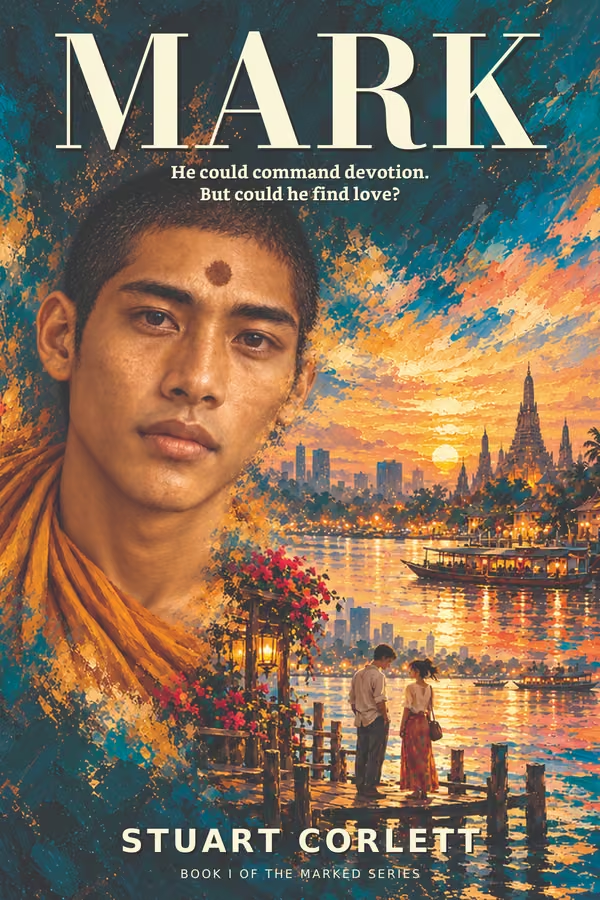
MARKED · Book 1 · Stuart Corlett
He could command devotion. But could he find love?
A remarkable gift. An impossible question about love.
Also available from
Paperback on AmazonCheck the selected retailer for prices, delivery and availability.
Born into poverty beside the Mekong River, Narin carries a mysterious round birthmark at the center of his forehead—a mark that draws people into stillness and gives him an influence he does not yet understand.
Sent as a child into the discipline of the monkhood, he grows into a man torn between reverence, temptation, guilt, and the dangerous power of attention.
When he meets Araya, a brilliant artist devoted to transforming poverty through beauty and creativity, their love opens a new path: one rooted in consent, compassion, imagination, and creative love.
Read before you choose
Chapter One · The Small Circle
The Mekong did not hurry past Ban Sang Dao. It moved with the grave, brown patience of something older than the names of countries, older than the checkpoint upriver, older than the red and white Thai flag that snapped in the wet season wind and the Lao hills that rose blue and folded on the far bank like sleeping animals under rain.
At dawn, before the heat climbed out of the mud, the river looked almost silver. Nets hung from bamboo poles like torn pieces of night. Long-tail boats nosed through the mist with their engines coughing and trembling, then fell quiet where the fishermen cut them and drifted. Egrets stepped through the shallows with the delicate suspicion of old women. Water hyacinth moved in green rafts, caught for a moment against the roots of tamarind trees and then released again, carrying with it cigarette packets, mango leaves, a child's broken sandal, a plastic bottle with a blue cap, half a garland browned by the sun.
That was how Preecha found things. He found them where the river and the road forgot what they had thrown away.
He had a cart made from bicycle wheels and rusted pipe, and every morning before first light he pushed it along the narrow lane behind the temple wall, past the houses lifted on posts, past hens scratching in the dust under sleeping rooms, past dogs that knew him and did not bark. He collected bottles, wire, torn sacks, bits of corrugated iron, cardboard swollen by rain, anything that could be weighed by the woman with the scale behind the noodle shop. On lucky days he found copper. On very lucky days he found something still useful: a cracked basin that could hold water if turned the right way, a shirt with only one sleeve torn, a broken fan that might surrender a motor if struck gently with a stone and patience.
People called him poor because there was no easier word. It was not wrong, but it was too small. Poverty was not only the absence of money in his pocket. It was the particular angle of his shoulders when he saw a doctor sign. It was the speed with which he counted coins before buying fish sauce. It was the way he learned to laugh before anyone could pity him. It was his wife's hands, red from washing clothes that belonged to other people, folding silk shirts she would never wear and school uniforms their unborn child might never afford.
End of sample · © Stuart Corlett
Keep exploring
In northern Thailand, twins confront an emotional technology that can soothe suffering—and quietly make resistance impossible.
View bookAt a forest monastery, Arun's encounter with a wounded tigress draws him into a story of fear, empathy and the lives people share with animals.
View bookA young Ukrainian inventor begins turning the fragments of war into a vision of protection, as courage, love and conscience shape what he builds.
View book
